About the Cards
Photo Gallery
How To Build It
Tips & Techniques
Read More About It
Free Models
Order Cards
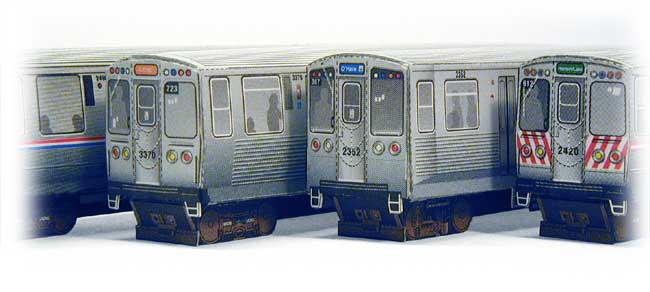
Elevated Train modelsL Train

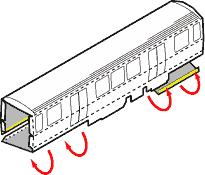
fig. 1

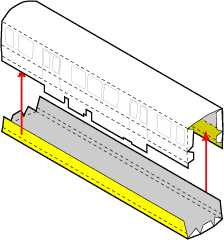
Before you cut out the body of the train, score the dotted lines along the edges of the rooftop and where the sides meet the bottom panels of the train car. Examining the diagram (fig. 1), note that the electrical boxes along the center of the train are meant to hang straight down along the side of the train, instead of being folded underneath.

The Blue Line cars are boxy, with simple straight vertical side walls, but the Red, Green and Orange Line cars have sides which bulge outward slightly. Bend the sides outwards with a gentle mountain fold just below the windows and a valley fold along the bottom of the doors. See Tips and Techniques for more about how to do this.

After all scoring is complete, cut out the body of the train. Use a round pencil or dowel to curl the roof of the train just a bit to make a round roof.

Fold in the tabs at the ends of the car. Fold the bottom panels under the train and glue these to inside of the opposite walls (fig. 1). Your train should be a long, open-ended tube at this point.

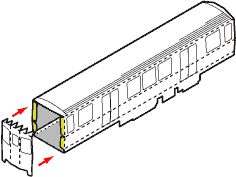
fig. 2

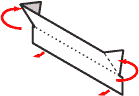
Cut out the front and back ends of the train. Fold the pointed tabs back at a 90-degree angle. Give the front and back pieces a slight outward angle by bending gently along the vertical dotted lines between the door and windows.

Glue the front and back to the train by tucking the tabs on the top and bottom of the end pieces inside the body of the train as you put them together (fig. 2). Be sure to glue the front to the end of the body marked front and the back to the back!


fig. 3

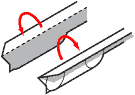
Cut out the wheels of the train and fold lengthwise. Note that this fold is a valley fold: the printed wheels on the card should face outwards with the folded over words facing downwards at a 90-degree angle above them (fig. 3).

fig. 4

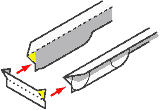
Cut out the couplers. Fold the side tabs backwards at a 90-degree angle and valley fold the bumper slightly forward so that the lower part will be vertical when connected to the rest of the train in the next step (fig. 4).

fig. 5

Glue the bumpers to the long wheel pieces with a little glue on the small triangle tabs. Strengthen the connection with a drop of glue on the inside of the corners after the first glue has dried (fig. 5).

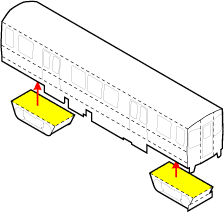
fig. 6

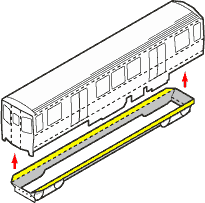
Finish the model by gluing the wheels to the underside of the train. Be sure to match the front wheels to the front of the car and back wheels to the back of the car, as indicated.

Your train is now finished! The real L trains always travel in twos, coupled at the back end of each car. Why don't you build another one and have a complete set?

Read more about CTA Elevated system


Copyright 2007 Matt Bergstrom